
Nipple Shields: Matching the Tool to the Clinical Indication
Categories: breastfeeding & lactation, feeding babies & kids, postpartumTags: baby, breastfeeding
July 17, 2026
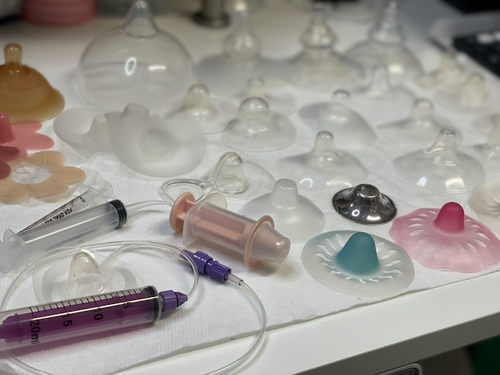
They give out nipple shields like they are candy over at that hospital.”
“My baby won’t latch without a nipple shield.”
“Breastfeeding is going great…I’ve been using a nipple shield.”
“If you are using a nipple shield, you need to make sure you pump, too.”
These are all common things we say or hear.
As a lactation or perinatal professional who supports people with nursing babies, how many nipple shields do YOU own?
I own all of them. Or close to it.
Every conical, every cherry shape, every weird unnamed one I bought on Amazon because I was curious. The ones I find most helpful are in an apothecary jar in my office, and yes, they are cleaned before I try them with a client. It's a whole thing.
I've also put every single one of them in my own mouth. You know, just to try them. (These are the ones that are NOT used with clients, even though they ARE sanitized after I do this.)
I know, I know. I have an adult mouth, not a baby's mouth, and I can purposely control my suckle in a way a newborn can't. But sucking on nipple shields and bottle nipples myself has taught me things I never would have learned just looking at them on a shelf — which ones make my tongue do something I didn't tell it to do, which ones feel slippery no matter how hard I flare my lips, which ones have an edge that scrapes, even though it's "just silicone."
If you've never tried this, I really want you to. It's oddly one of the most useful five minutes of continuing ed you can give yourself.
Here's the thing about nipple shields: almost everyone uses them, but almost nobody was taught *how* to choose one on purpose. Most of us grab whatever's in the drawer, or whatever the hospital hands out, and hope for the best.
I just completed my new course on nipple shields for lactation and perinatal professionals, if you want to learn more!
And to be clear — this is not about fitting a nipple shield to the nipple the way we fit a flange to the nipple. I get asked this repeatedly, and the answer is NO. It is NOT the same thing—not even close. We're not measuring. We're trying to get the baby's mouth open as wide as possible around as much breast tissue as we can, while the parent stays comfortable and the baby actually transfers milk. That's the goal.
A few things I dig into in the course that tend to surprise people:
** The "you have to pump if you use a shield" rule is outdated.** That used to be the blanket advice, based on the idea that shields are too thick for adequate stimulation. For most shields on the market now, that's just not true anymore. The real question isn't "is there a shield on there" — it's "is this baby actually transferring milk effectively." If yes, pumping on top of that may not be necessary at all.
** Shape matters more than people think.** Conical vs. cherry-shaped isn't just a style preference — I reach for a cherry shape constantly for babies who keep sliding down a conical and climbing back up, especially with tongue tie or other oral function struggles. Size matters too, in both directions: too small, and I've genuinely seen a nipple get pulled all the way up to the tip of the shield during a feed. Not great.
** Some of the newest shields on the market are genuinely interesting** — one has channels so parents can watch milk move (with some real caveats about what that visual actually tells you), another changes clarity with warmth against the skin. And a few, I'll just say it plainly, worry me. One style in particular rides up toward the baby's nose in a way that reads as a real suffocation risk to me. I'll show you exactly which ones and why.
** There's a trick for using a supply line with a nipple shield** that I learned from Melissa Cole, IBCLC, that makes the whole setup dramatically easier — enough that I'm sometimes tempted to introduce a shield to a dyad just to make the supply line part simpler. (I don't. But I'm so tempted.)
** A cut shield doesn't have to just be a mistake.** I take a wedge out of shields on purpose to protect a sore spot at the base of the nipple during pumping, or to relieve pressure right where it hurts. And for anyone who's heard the rumor that a cut edge is sharp — it's not. I've cut plenty of these and they stay completely soft.
I've got a whole framework for this kind of creative, off-label problem-solving, actually. We call this a “hack”…and I’ve created an acronym for H.A.C.K. that I think you’ll appreciate. Because using a tool in a way it wasn't originally marketed for isn't cutting corners. It's clinical skill.
And underneath all of it is the bigger reason this matters: shields are everywhere in hospitals right now, largely because staff need to document one successful latch before discharge. Totally understandable. Nipple shields are helpful tools. I’m NOT against them.
But then parents go home, and the underlying reason the shield was needed — swelling, tongue tie, torticollis — never gets addressed, and nobody's following up. The shield becomes something they feel they continue to need, it falls off often, gets lost, gets cat/dog fur on it from the floor, and nursing with it starts to feel like too much of a nuisance. That's how people stop breastfeeding — not because they didn't want to, but because the tool that was supposed to help became the obstacle.
On the flip side — some parents and babies will need a shield indefinitely, and that is completely fine. Even a parent who isn't producing their own milk and is using donor milk or formula through a shield is still nursing their baby. That's real progress, and it deserves to be celebrated.
When it is time to work toward weaning off a shield, I've got a couple of go-to approaches — including one I call the "I just can't find it" method, which keeps the whole thing low-pressure for a parent who's finally starting to feel confident.
Getting good at choosing, applying, and eventually weaning off nipple shields isn't just gear trivia. It's one of the things that keeps people nursing. It's also something you can advocate for at an institutional level — if your hospital only stocks conicals, you can be the one who asks why cherry-shaped shields aren't on the shelf too.