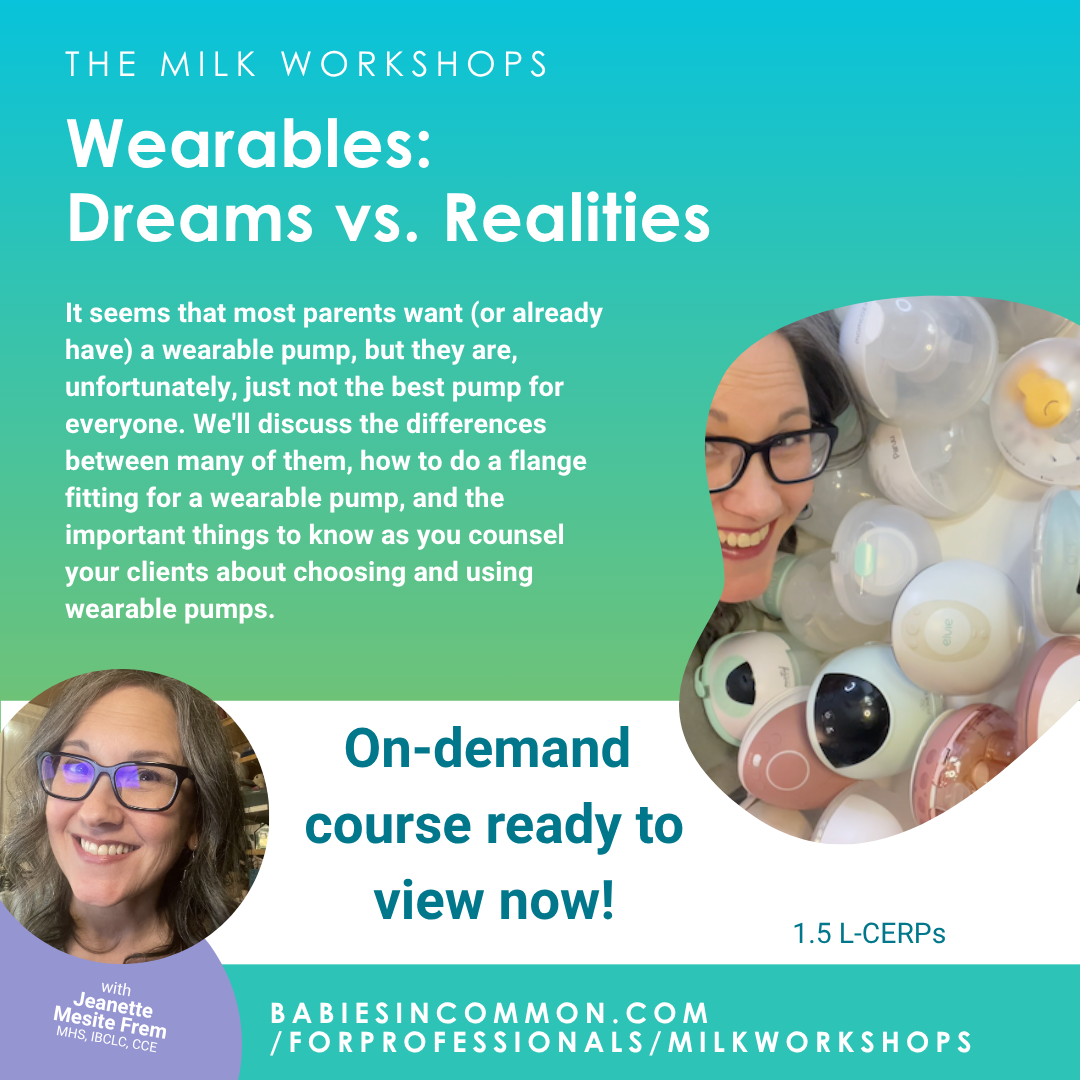
It seems that most parents want (or already have) a wearable pump, but they are, unfortunately, just not the best pump for everyone. In this on-demand course, you'll hear about (and see!) the differences between many different wearable pumps and milk collection cups, how to do a flange fitting for a wearable pump, and the important things to know as you counsel your clients about choosing and using wearable pumps.
More and more parents today are using one of many wearable pumps (wearing the pump in the bra to yield milk without being tethered to a pump with tubing that attaches to a larger pump). Additionally, more lactation professionals are seeing negative impacts from people using these devices. During this session, we will explore where there might be risks in addition to the perceived or real benefits of these devices. Many of the wearable pumps on the market today will be presented, as well as the nuances of how to take them apart and put them back together (as they aren’t uniformly designed and some are more complex than other). Approaches to their use will be presented, as well, including how to do a high-quality flange fitting for using a wearable pump.
-
Wearable Pumps: Dreams vs. Realities$67 | 2 hours | 1.5 L‑CERPs approved by IBCLE, C2026291 as of 4/16/2026. Six months viewing access included.
- or, sign up for one of the MILK Workshops packages to get this workshop and more!
About Your Workshop Facilitator
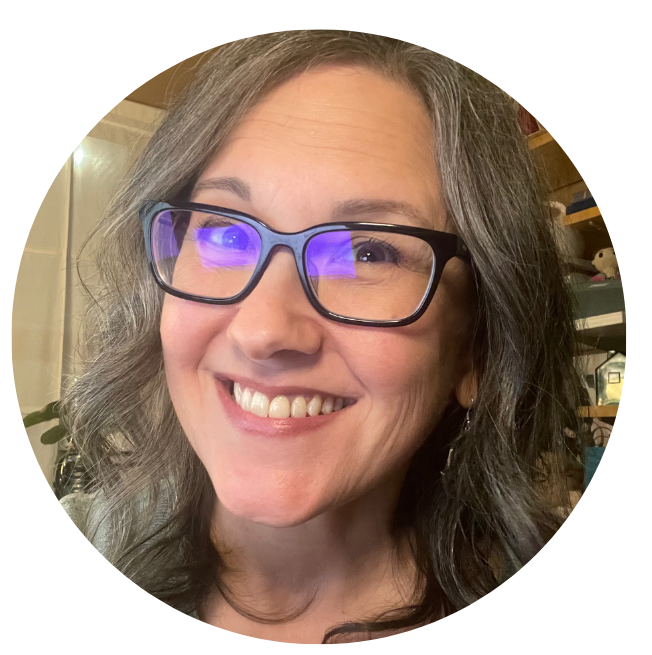 This course is led by Jeanette Mesite Frem, MHS, IBCLC, CCE of Babies in Common, who is an International Board Certified Lactation Consultant and experienced childbirth educator. Jeanette does flange fittings and pumping sessions with most of her clients as well as many bottlefeeding sessions and consultations about bottle challenges (and yes, she still loves supporting families with breastfeeding/chestfeeding and hand expression!). She's collected and used many pumps, bottles and other gear with her clients in her practice and is is experienced with virtual consultations and using props for teaching parents and will utilize those skills during this online workshop.
Jeanette has spoken about flange fitting to about 20,000 IBCLCs and perinatal professionals globally about flange fitting and is dedicated to changing how parents pump...and she is currently the co-investigator of the first ever flange fitting study that compares standard sizes with smaller sizes, using her approach to flange fitting (with lead investigator Dr. Lisa Anders of University of North Carolina Greensboro).
Jeanette is an experienced childbirth educator, IBCLC-lactation consultant and retired birth doula. She started her career working with families while serving as a Peace Corps Volunteer in Côte d'Ivoire, West Africa in the early 90s. She loved that work so much she went on to receive a public health masters degree from Johns Hopkins School of Public Health, focusing her studies on nutrition for maternal and child health. Her two children were breastfed for more than 2 years each and Jeanette has experience pumping at work for both children and has supported more than a thousand families with breastfeeding, chestfeeding, pumping, bottlefeeding, cupfeeding, tubefeeding, etc. over the years.
Jeanette provides prenatal childbirth and breastfeeding classes at her office in Northborough, Massachusetts, as well as providing virtual feeding consultations as well as in her office. She also enjoys leading workshops for perinatal health professionals and mentoring those who work with families. If you have questions, feel free to email jeanette@babiesincommon.com.

Babies in Common has been accepted by the International Board of Lactation Consultant Examiners® (IBLCE®) as a Preferred Provider for the listed Continuing Education Recognition Points (CERPs) programme. Determination of CERPs eligibility or CERPs Provider status does not imply IBLCE’s endorsement or assessment of education quality. As a Preferred Provider, Babies in Common attests that it complies with the WHO Code and subsequent WHA resolutions.
NOTE: Taking any handout, workshop, webinar, or online course offered by Jeanette Mesite Frem/Babies in Common) is for your information, to be used in your clinical practice. No one is permitted, without my expression permission to take what they learned in any educational offering hosted or provided by Jeanette or Babies in Common, or colleagues collaborating with Jeanette/Babies in Common, and then teach it as their own. My/our intellectual property is my/our own, as much as how I/we teach it, the approach, the nuances, any documents, statements, slides, forms, handouts, graphics, etc. It is unfortunate that I need to say this, but unfortunately, I do. Thank you for understanding and for being an ethical provider of lactation and perinatal care. ~ Jeanette Mesite Frem, Babies in Common