
Measuring Nipples: Just a Minor Part of the Story
Categories: breastfeeding & lactation, pumpingTags: breastfeeding
June 23, 2026
Whether you are a parent, are expecting a baby, or work with families who have babies, I think you'll find something useful (and maybe a little surprising!) in this one, Measuring Nipples: Just a Minor Part of the Story...
Flange sizing is a major topic in the world of lactation right now. You've heard about "going smaller." Some are calling this a fad. Others say it causes pain and damage (it doesn't, if done the way I recommend).
I call it revolutionary.
If you've already tried different sizes and shapes based on nipple tip size* and found that it works wonders—awesome. You know how impactful this can be.
Perhaps you are a doubter—if yes, please stay with me.
Parents and lactation/perinatal professionals are hearing about this "new" way of doing things, but they're confused because they're being told different things by many people: nurses and LCs in the hospital, influencers on social media (some of whom have never actually seen another person pump), and friends and family in our social (media) groups. What is a parent or lactation professional or perinatal professional to do?
Try it. Please.
I know, I hear the outcry: "where's the evidence?" And yes, the one published study using the Flange FITS™ Guide is small with its own limitations. But remember, evidence-based practice has three parts: research evidence, clinical experience, and patient preference.
There was never research evidence for why 24mm or 25mm became the "standard" flange size. Read that again.
Nearly all published pumping research only included people using standard sizes, or perhaps down to 21mm. But in my clinical experience, most people should be using 12mm–16mm—some as small as 9mm. When someone whose ideal size is 13mm tries a 17mm or larger, they often have more pain and reduced milk yield as the nipple swells. When they try their ideal size and shape, they find ultimate comfort and more milk sprays than ever before.
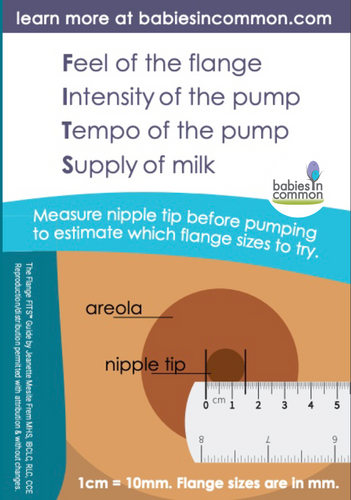
Measuring the nipple tip (stimulated gently for 10–20 seconds) is just a starting point. A person measuring at 13mm should try 12mm, 13mm, and 14mm—it's remarkable how 1mm changes comfort and flow. Then there are different shapes, hard or soft flanges, varied pump settings, and it's best to try a different pump altogether.
Honestly, flange fitting sessions are the most fun I have as a lactation consultant. Yes, consultations that include flange fitting sessions take longer—but when someone finds ultimate comfort and better milk yield, they pump more, and that gets more human milk to babies. Who doesn't think that's a good idea?
I hope you're curious about what you can do to improve the services you're providing. I've devoted most of my workdays over the last five and a half years to learning everything I can about flange fitting and pumping—and I'm still learning.
I hope you're fascinated and excited by all of this, too.
Questions? Email jeanette@babiesincommon.com
If you are a parent, please download the Flange FITS™ Guide today!
If you are a lactation or perinatal professional, check out the live, pre-recorded, and in-person opportunities for continuing education here.